Designing Your Smile From the Outside In: The Science of Facial Proportion in Cosmetic Dentistry
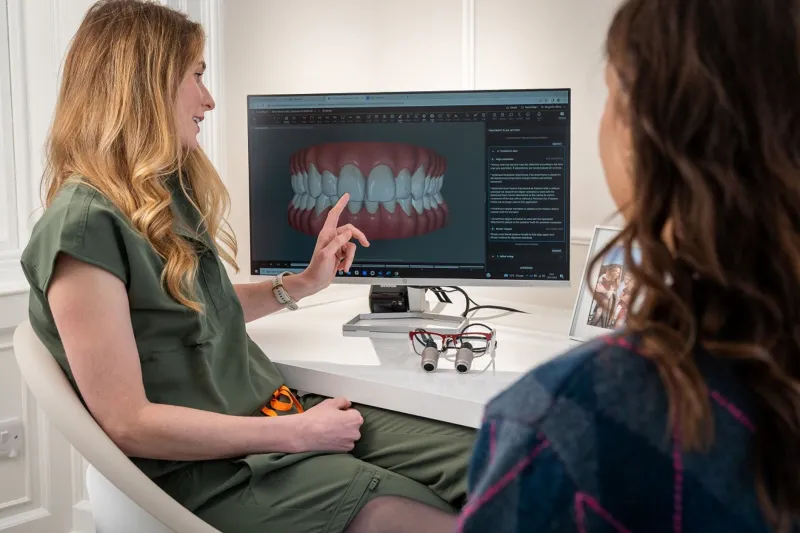
When most people imagine a smile transformation, they picture the end result: gleaming, symmetrical teeth that seem to belong on a magazine cover. What rarely enters the picture is the meticulous planning that precedes any procedure — the careful study of bone structure, soft tissue, facial thirds, and individual proportion that separates a genuinely beautiful outcome from one that simply looks dental.
At Artisan Dental Studio, every cosmetic treatment begins not with a drill or a veneer mold, but with a conversation about your face as a whole. Understanding that process can help you become a more informed participant in your own care.
Your Face as a Canvas
The human face is not a uniform structure. It is shaped by genetics, age, ethnicity, and life experience — and no two faces present the same set of proportions. A skilled cosmetic dentist approaches each patient the way a portrait artist approaches a new subject: by observing before acting.
One of the foundational tools in smile design is the concept of facial thirds. Clinicians divide the face horizontally into three roughly equal zones: the upper third (forehead to brow), the middle third (brow to the base of the nose), and the lower third (base of the nose to the chin). The lower third is particularly relevant to dentistry because it encompasses the lips, teeth, and jaw — the very structures that define a smile's relationship to the rest of the face.
When the lower third is disproportionately short due to tooth wear or bone loss, even perfectly shaped veneers can look out of place. Conversely, restorations that restore appropriate vertical dimension can subtly rejuvenate the entire face without a single cosmetic surgery procedure.
The Golden Ratio and Why It Matters
You may have encountered the golden ratio — approximately 1:1.618 — in discussions of art, architecture, or nature. Its relevance to dentistry is more than aesthetic philosophy. Research has long suggested that human perception of beauty correlates with proportional relationships that approximate this ratio, and cosmetic dentists use it as a guiding principle when determining tooth width, length, and spacing.
In practical terms, the golden ratio influences decisions such as how wide the central incisors should appear relative to the lateral incisors, and how the lateral incisors should relate to the canines. These proportions create a visual rhythm — a kind of dental harmony — that the eye registers as natural even if the viewer cannot articulate why.
Importantly, the golden ratio is a reference point, not a rigid prescription. A dentist who applies it mechanically without accounting for the patient's unique facial geometry risks producing a smile that looks technically correct but personally wrong.
Buccal Corridors: The Space That Frames the Smile
One of the more nuanced concepts in smile design is the buccal corridor — the dark space visible at the corners of the mouth when a person smiles broadly. This space exists because the dental arch is narrower than the full width of the lips.
For years, the prevailing instinct was to minimize buccal corridors as much as possible, often by widening arches or adding posterior veneers. More recent thinking is considerably more nuanced. Some degree of buccal corridor is actually associated with a natural-looking smile; eliminating it entirely can produce a result that appears overly wide or artificially uniform — what some clinicians informally call the "Hollywood slab" effect.
The appropriate corridor width depends on the patient's facial width, lip mobility, and the overall smile design goals. A broader face may accommodate a fuller dental arch without appearing unnatural, while a narrower face may benefit from a more conservative approach. This is precisely the kind of individualized judgment that distinguishes artisan-level cosmetic dentistry from volume-driven, one-size-fits-all treatment.
Gum Architecture: The Frame Around the Art
Teeth do not exist in isolation. They emerge from gum tissue that has its own contours, heights, and symmetry — or lack thereof. Gum architecture, sometimes called the gingival frame, plays an enormous role in how a smile is perceived.
Ideal gum contours follow a specific pattern: the gum line of the central incisors and canines typically sits at the same height, while the lateral incisors sit slightly lower. Deviations from this pattern — whether due to genetics, gum recession, or previous dental work — can make an otherwise attractive smile appear uneven or aged.
Cosmetic procedures such as crown lengthening or gum contouring can reshape this frame before restorative work begins, ensuring that veneers or crowns are placed against an optimal backdrop. Skipping this step is one of the most common reasons that otherwise technically sound restorations fail to achieve their full aesthetic potential.
Lip Dynamics and the Smile in Motion
A smile is not a static photograph — it is a dynamic expression that changes with movement, emotion, and speech. Experienced cosmetic dentists evaluate not only how your teeth appear at rest, but how they interact with your lips and facial muscles during a natural, spontaneous smile.
Factors such as lip line (how much tooth structure is visible when you smile), lip fullness, and upper lip mobility all influence treatment decisions. A patient with a high lip line — one that reveals a significant amount of gum tissue — requires more careful attention to gum architecture than a patient whose lips naturally conceal the gingival margin. Similarly, tooth length choices that look balanced at rest may appear disproportionate in full animation if lip dynamics are not accounted for.
Why Personalization Is Not a Luxury — It Is the Standard
The principles described above are not exotic refinements reserved for extreme makeover cases. They are the baseline considerations that any competent cosmetic dentist should bring to every consultation. What varies is the degree of rigor and artistry applied.
At Artisan Dental Studio, the belief is straightforward: a smile that does not harmonize with the face that wears it is not a success, regardless of how flawless the individual restorations may be. The goal is never to impose a predetermined aesthetic onto a patient's face, but to discover and amplify what is already uniquely theirs.
Understanding these concepts before your first cosmetic consultation allows you to ask more meaningful questions, evaluate proposed treatment plans more critically, and ultimately participate as a genuine collaborator in your own care. Your face is the canvas. The design should honor it.