Worn Down Before Your Time: The Hidden Epidemic of Nighttime Grinding and What It Costs Your Smile

There is a particular cruelty to damage that accumulates while you sleep. You cannot witness it, you cannot stop it in the moment, and by the time it becomes visible, years of wear have already been compressed into what might otherwise have taken decades. Bruxism—the habitual clenching and grinding of teeth, most often occurring during sleep—operates precisely this way. It is quiet, consistent, and profoundly destructive to the very architecture of your smile.
Estimates suggest that between 10 and 15 percent of American adults grind their teeth with enough regularity to cause measurable harm. Dental professionals, however, suspect the true number is considerably higher, particularly in the aftermath of sustained national stress events that have redefined how Americans sleep, rest, and recover.
Why Modern Stress Has Become a Dental Problem
The jaw is one of the body's most powerful muscle systems. When stress hormones remain chronically elevated—as they do for many adults navigating demanding careers, financial pressures, and the ambient anxiety of contemporary life—the musculature of the face and jaw often responds by holding tension. During waking hours, most people can consciously release that tension. During sleep, there is no such override.
The result is a nightly cycle of grinding and clenching that can generate forces far exceeding those produced during normal chewing. Where chewing exerts roughly 20 to 40 pounds of pressure per square inch, bruxism can produce forces exceeding 250 pounds. Applied night after night, those forces do not simply wear teeth down—they fracture enamel at the microscopic level, compress the jaw joint, and alter the dimensional relationships that give a smile its proportion and vitality.
This is not merely a mechanical concern. The aesthetic consequences of chronic bruxism are among the most visually significant and least understood forms of dental aging.
What Grinding Actually Does to Your Smile's Appearance
Healthy, youthful teeth possess a specific geometry. The front teeth are longer, with gently rounded incisal edges that catch light and create dimension. The back teeth maintain cusps that support vertical height throughout the face. Together, these structural details contribute to a smile that reads as full, proportionate, and alive.
Bruxism systematically erodes that geometry. The incisal edges of the front teeth flatten and shorten. As vertical height collapses, the lower third of the face begins to compress—deepening the nasolabial folds, thinning the lips in appearance, and producing a prematurely aged facial profile. This is a phenomenon entirely distinct from the skin-level aging that most people associate with growing older. It originates in the dental structure itself.
Additionally, grinding produces a characteristic wear pattern that a trained clinician can identify with high confidence. Unlike the generalized wear that results from diet or poor brushing technique, bruxism wear is bilateral, concentrated on opposing surfaces, and often accompanied by microfractures, chipping at the enamel margins, and sensitivity that patients frequently misattribute to other causes.
Detection: Recognizing the Signs Before the Damage Is Severe
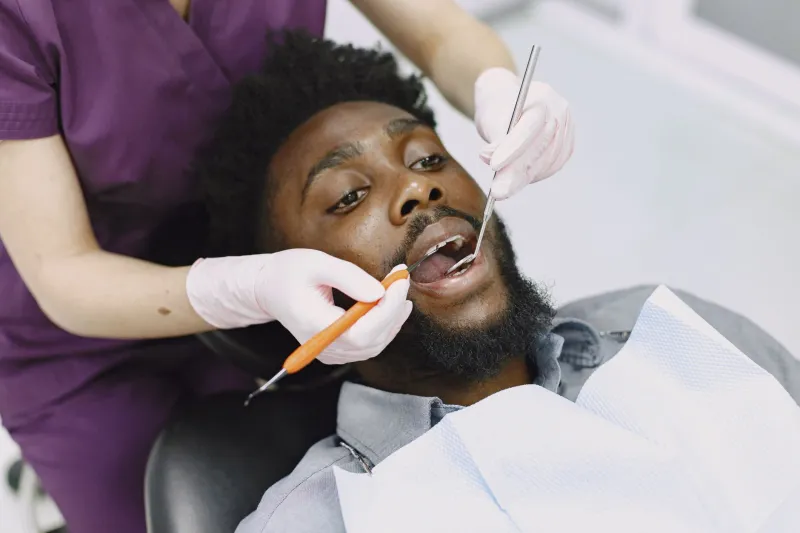
Because most grinding occurs during sleep, many patients arrive at the dental chair genuinely unaware of the habit. A comprehensive examination, however, reveals a detailed record of what has been happening.
Dental professionals assess wear facets—the flattened, polished surfaces that indicate tooth-against-tooth contact under pressure. They evaluate the condition of the temporomandibular joint, looking for tenderness, clicking, or restricted range of motion. They examine the gum line for abfraction lesions, which are V-shaped notches at the base of teeth caused not by brushing but by the flexion of tooth structure under lateral grinding forces. Scalloping on the tongue and linea alba—a whitened line running horizontally along the inner cheek—can further confirm chronic clenching behavior.
Patients themselves often report waking with jaw soreness, facial tension, or headaches concentrated at the temples. Some notice increased tooth sensitivity or observe that their teeth look shorter than they once did. A sleep partner may report audible grinding sounds during the night. Any combination of these signals warrants prompt evaluation.
Restorative Dentistry as an Anti-Aging Strategy
The encouraging reality is that bruxism damage, even when it has progressed significantly, is addressable. The artisan philosophy of restorative dentistry approaches this damage not as a problem to be patched but as an opportunity to thoughtfully reconstruct what has been lost—with an eye toward both function and the refined aesthetics that a healthy smile conveys.
For patients with mild to moderate wear, occlusal splints—custom-fabricated nightguards that position the jaw in its most relaxed posture—interrupt the grinding cycle and prevent further damage. These devices are not interchangeable with the generic trays available at pharmacies; a properly designed splint accounts for the precise occlusal relationships unique to each patient's bite.
Where structural loss has already occurred, restorative intervention becomes necessary to reclaim lost vertical dimension and surface integrity. Porcelain veneers, full-coverage ceramic crowns, and composite restorations can be precisely calibrated to restore the original proportions of the teeth—returning length to the incisors, rebuilding cusp height in the posterior teeth, and re-establishing the facial support that grinding had gradually eroded.
This process is not cosmetic in the superficial sense. It is corrective architecture. When executed with precision and an understanding of how the teeth relate to the face as a whole, the transformation is indistinguishable from the kind of natural, youthful dental structure that the patient had before bruxism intervened.
The Value of Intervening Early
Dental enamel does not regenerate. Every fraction of a millimeter lost to grinding represents a permanent reduction in the tooth's natural structure—a resource that, once spent, can only be replaced with restorative materials, however sophisticated those materials may be. This reality makes early intervention not merely advisable but genuinely consequential.
Patients who address bruxism proactively—before wear has progressed to the point of structural compromise—preserve options that later stages of damage foreclose. They maintain more of their natural tooth structure, require less invasive treatment, and retain a greater degree of the biological and aesthetic integrity that makes a smile look authentically theirs.
In this sense, treating bruxism is one of the most effective anti-aging investments a person can make in their smile. Not because it reverses the clock in some superficial sense, but because it stops an accelerated aging process that has nothing to do with the passage of time and everything to do with forces that can, with the right care, be interrupted and corrected.