When Your Smile Tells the Wrong Story: Closing the Gap Between Who You Are and How You Appear

There is a particular kind of frustration that is difficult to articulate — the sense that the person others see is not quite the person you know yourself to be. You may carry warmth, confidence, and vitality on the inside, yet hesitate before every photograph, suppress laughter in a crowded room, or speak with a hand hovering near your mouth. The culprit, more often than people realize, is a smile that has quietly fallen out of alignment with the self it is meant to express.
This is not vanity. It is identity — and the distinction matters enormously.
The Invisible Weight of a Mismatched Smile
Psychologists have long studied the concept of self-congruence: the degree to which a person's external presentation aligns with their internal self-concept. When that alignment breaks down, the psychological toll can be significant. Research consistently shows that people who perceive a gap between how they see themselves and how they believe others perceive them report higher levels of social anxiety, diminished self-esteem, and a reduced willingness to engage in professional and personal opportunities.
For a surprising number of Americans, the smile sits at the center of this disconnect. Consider the professional who projects authority in every meeting yet dreads client introductions because chipped or discolored teeth feel incongruent with the competence she knows she possesses. Or the newly retired grandfather who has finally found joy and ease in his later years, yet whose aged, ill-fitting dental work communicates something more worn and defeated than the man he has become. In each case, the smile is not merely an aesthetic concern — it is a narrative problem. The story the mouth tells does not match the story the person is living.
How Dental Histories Shape Present-Day Disconnects
The misalignment between self and smile rarely appears overnight. More often, it accumulates gradually, shaped by years of deferred care, outdated dental work, or the slow drift of teeth over time.
For some patients, the disconnect traces back to childhood or adolescence — a period when dental care was inconsistent, finances were limited, or treatment options were simply more primitive than what exists today. Amalgam fillings that once seemed unremarkable now draw the eye. A bridge placed two decades ago may have served its functional purpose admirably, yet its appearance belongs to an earlier era of dentistry. These restorations were not failures; they were solutions appropriate to their time. But time, inevitably, moves on — and sometimes the dental work does not move with it.
For others, the issue is physical drift. Teeth shift throughout a person's life, responding to bite pressure, aging bone structure, and the subtle forces of daily use. A smile that was once reasonably aligned may have gradually crowded, spaced, or rotated in ways that feel increasingly foreign to the person wearing it. The smile in the mirror begins to feel like a stranger's.
There is also the matter of neglect — not always born of indifference, but frequently of circumstance. Career transitions, family obligations, financial pressures, and the persistent anxiety that keeps so many Americans away from the dental chair can allow years to pass without meaningful care. When patients finally return, they often describe a startling moment of recognition: the face looking back at them in a clinical mirror no longer reflects the life they have built.
Cosmetic and Restorative Dentistry as an Act of Alignment
At Artisan Dental Studio, we approach smile transformation not as a superficial exercise in aesthetics, but as a deliberate act of realignment — restoring coherence between the person a patient is and the smile through which they meet the world.
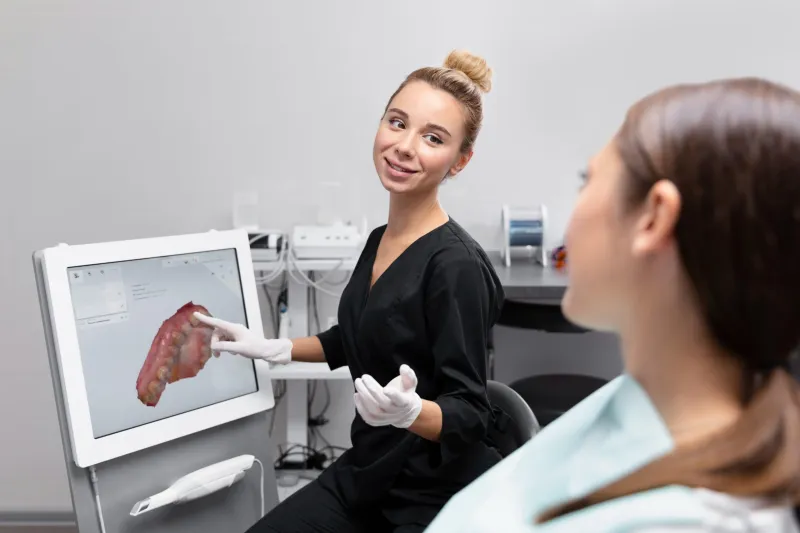
This begins with listening. Before any treatment plan takes shape, the most important conversation is one about identity: How do you see yourself? What qualities do you want your smile to reflect? Is the goal warmth, professionalism, vitality, approachability? These are not trivial questions. They are the foundation upon which genuinely personalized dentistry is built.
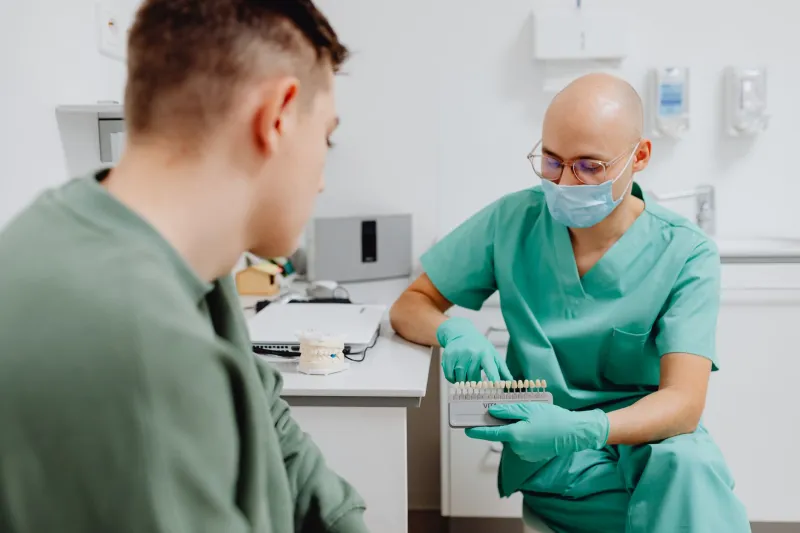
From there, the clinical possibilities are both broad and precise. Porcelain veneers, for instance, can address a constellation of concerns — discoloration, chips, minor misalignment, proportion — within a single, cohesive treatment. Because each veneer is individually crafted, the result is a smile that reads as natural rather than constructed, expressive rather than uniform. For patients whose disconnect stems from missing or failing teeth, implant-supported restorations offer a permanence and authenticity that removable options simply cannot replicate. Clear aligner therapy, meanwhile, can quietly correct the gradual shifts that have accumulated over years, restoring a structural harmony that patients often describe as feeling like a return to themselves.
What unites these treatments is not the technology — it is the intention behind them. Dentistry that closes the gap between inner and outer self is dentistry practiced with both clinical precision and genuine attentiveness to the human being in the chair.
The Moment of Recognition
Patients who have undergone meaningful smile transformation frequently describe a specific moment — not always the final reveal, but sometimes a quiet Tuesday morning, catching their reflection while brushing their teeth — when they realize the disconnect has closed. The face in the mirror matches the person behind it. There is no longer a small, persistent friction between self-perception and outward presentation.
One patient, a woman in her early fifties who had spent years hiding her smile behind years of worn-down enamel and an outdated partial, described it this way: "I didn't realize how much energy I was spending managing how I looked until I stopped having to manage it. I just smiled. That was new."
That simplicity — the ability to simply smile — is, in many respects, the entire point.
A Smile Worth Recognizing
If you have ever felt that your smile does not quite tell the truth about who you are, that feeling deserves to be taken seriously. It is not a minor complaint or an indulgence. It is a signal that something fundamental to your self-expression has been left unaddressed.
The artistry of modern cosmetic and restorative dentistry lies precisely in its capacity to honor that signal — to look closely at where a person is, understand where they want to be, and craft a path between the two with both scientific rigor and genuine care. The result is not merely a more attractive smile. It is a more honest one.
And that, ultimately, is a transformation worth making.