Born With It or Built for It: Reclaiming Your Smile From Your Family Tree

The Dental Traits You Did Not Choose
There is a particular moment many patients describe during their first consultation — a pause before answering the question of what they would change about their smile, followed by the words: "Well, everyone in my family has this." The crooked lateral incisor. The narrow arch. The gums that seem to swallow the teeth whole. The yellowish tint that no whitening strip has ever fully erased.
For generations, these traits have been passed down alongside eye color and cheekbone structure, treated as immutable facts of biology rather than conditions open to artistic intervention. And while genetics does, without question, shape the foundation of your oral anatomy, the boundaries of that influence are far narrower than most patients believe.
Modern dentistry — particularly the cosmetic and restorative disciplines — has expanded so dramatically in precision and possibility that the distinction between what you were born with and what you choose to present to the world has never been more meaningful.
What Genetics Actually Governs
To understand the opportunity, it helps to understand what heredity genuinely controls. Research consistently demonstrates that several dental characteristics carry a strong genetic component. Tooth size and shape are largely inherited — the width of your lateral incisors, the length of your central teeth, and the overall proportions of your dental arch reflect patterns running through your family line. Jaw structure, including the relationship between your upper and lower arches, is similarly heritable, which explains why malocclusion — misalignment of the bite — often appears across multiple generations.
Enamel thickness and its natural shade also have a genetic basis. Some individuals are born with thinner enamel that appears more translucent or more yellow, regardless of oral hygiene habits. Gum tissue height and the ratio of gum to tooth that defines your smile line are shaped in part by genetic programming. Even the tendency toward certain conditions — crowding, spacing, hyperdontia (extra teeth), or congenitally missing teeth — follows hereditary patterns.
What genetics does not dictate is permanence. Each of these characteristics can be addressed, refined, or transformed through thoughtful clinical artistry.
The Psychological Weight of Feeling Predetermined
Beyond biology, there is an emotional dimension to inherited dental traits that deserves honest acknowledgment. When a patient has spent decades looking at a parent or grandparent and seeing the same smile reflected back, the trait can begin to feel like identity rather than anatomy. Changing it may feel like a betrayal of lineage, or simply like an impossibility that has never been seriously considered.
This psychological anchoring is real and worth examining. Many patients arrive at a cosmetic consultation having quietly accepted dissatisfaction as their inheritance — a kind of resigned ownership of features they never chose. The result is often a subtle but persistent self-consciousness: a hand raised to cover the mouth mid-laugh, a closed-lip smile held carefully in photographs, a hesitation to engage fully in professional or social settings.
The important distinction to draw is between honoring your heritage and being constrained by it. Choosing to redesign aspects of your smile is not a rejection of where you come from. It is, rather, an act of personal authorship — an assertion that the face you present to the world can reflect who you are now, not only the biological blueprint you received at birth.
The Treatments That Rewrite the Blueprint
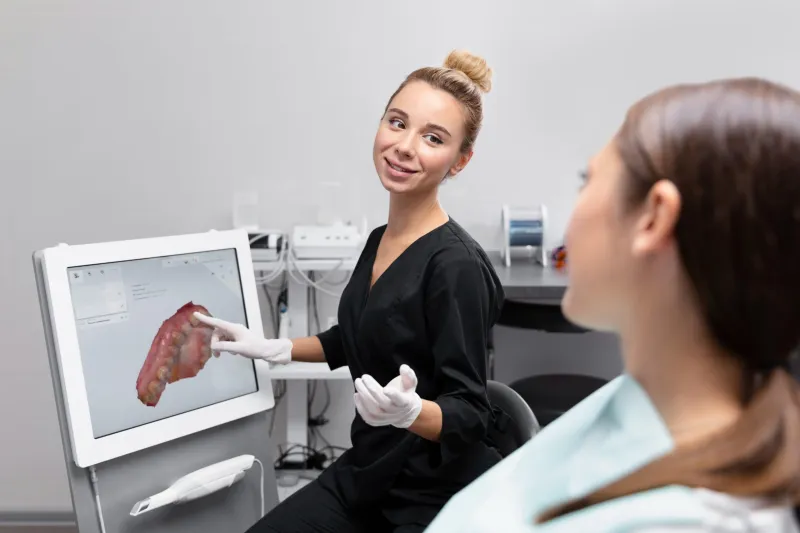
At Artisan Dental Studio, the approach to genetically influenced dental characteristics begins with a thorough understanding of each patient's facial anatomy, aesthetic goals, and the specific traits they wish to address. From that foundation, a range of treatments can be thoughtfully combined to produce results that feel both natural and intentional.
Porcelain Veneers remain one of the most versatile tools for transforming the visible architecture of a smile. For patients whose enamel is naturally thin, discolored, or poorly shaped — characteristics with strong genetic roots — veneers offer the ability to redesign tooth color, length, width, and surface texture simultaneously. Crafted from high-quality ceramic, they are designed to complement the patient's facial proportions rather than impose a generic aesthetic. The result is a smile that looks like the best version of you, not an approximation of someone else.
Orthodontic Treatment addresses the structural inheritance of jaw relationship and tooth alignment. Modern options, including clear aligner therapy, have made orthodontic correction more accessible and discreet than at any prior point in dental history. For patients whose crowding or spacing is a family pattern they have accepted as inevitable, the realization that alignment can be corrected at virtually any age is often quietly liberating.
Gum Contouring and Crown Lengthening address the gum-to-tooth ratio that defines so much of a smile's visual balance. A "gummy smile" — where excess gingival tissue obscures the full length of the teeth — is frequently an inherited characteristic. Through precise soft-tissue sculpting, the proportion of tooth visible within the smile can be recalibrated, revealing structure that was always present but never visible.
Composite Bonding and Tooth Reshaping offer more conservative options for patients whose primary concern is tooth shape or minor size discrepancies. For the patient who inherited unusually small lateral incisors — often called "peg laterals" — bonding or porcelain restorations can create the visual symmetry that genetics did not provide.
Teeth Whitening and Enamel Microabrasion address inherited discoloration and surface irregularities. While some genetic staining, such as that caused by tetracycline or fluorosis, requires veneer coverage for full correction, many cases of hereditary yellowing respond well to professional whitening protocols.
Designing a Smile That Is Authentically Yours
The artistry of cosmetic dentistry lies not in erasing what genetics provided, but in refining it into something that feels coherent and personal. At its best, a smile transformation does not announce itself — it simply makes the patient look more like themselves at their most confident.
This requires a collaborative process. A skilled clinician will study not only the teeth and gums in isolation, but their relationship to the lips, the midface, the jawline, and the patient's overall facial expression. The goal is harmony — a smile that belongs to the face it inhabits, shaped by both the patient's natural foundation and their deliberate choices.
If you have spent years accepting a smile trait as your inheritance, it may be worth reconsidering that assumption. Genetics offered you a starting point. What you do with it is yours to decide.
A consultation at Artisan Dental Studio begins with exactly that conversation — not with a treatment plan, but with a question: What does your ideal smile look like, and what has been standing between you and it? The answer, more often than not, is less permanent than you think.