Convenience Has a Blind Spot: What Mail-Order Smile Kits Still Cannot See
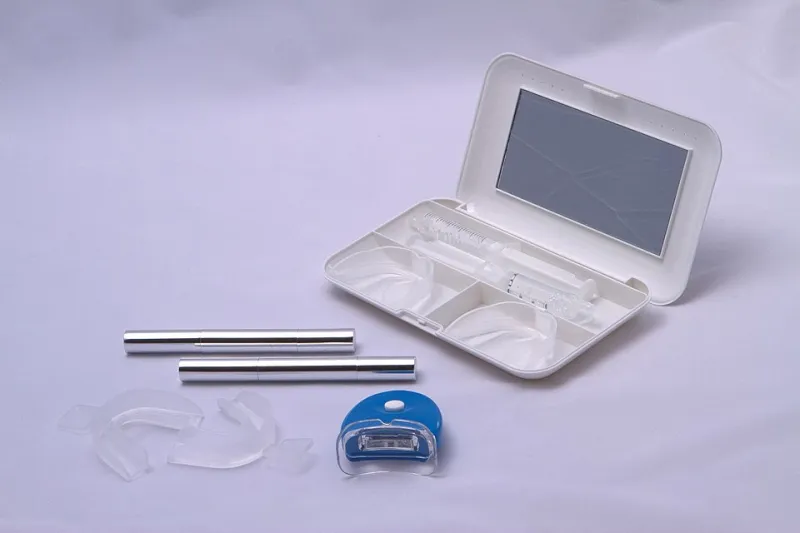
Photo: Teethguru, CC BY-SA 3.0, via Wikimedia Commons
There is a version of this essay that writes itself: the one where the dentist tells you that convenient things are bad and that you should come in more often. That version is not useful. Some direct-to-consumer dental products are legitimate, well-made, and appropriate. Others quietly route around the examination that would have caught a problem before it became expensive. The distinction is worth drawing carefully, because it is not about convenience versus professionalism. It is about what a kit can see and what it cannot.
The Allure of the Shortcut
The appeal is obvious. A tray arrives in the mail, a whitening gel is applied at night, a set of aligners shows up in a box with a schedule on the lid. There is no waiting room, no small talk, no cost estimate delivered while you are reclined and unable to reach your calendar. For adults who have avoided dental offices for years — often because of anxiety rather than expense — the mail-order route can feel like the first step that has ever seemed possible.
That matters. A patient who begins with an at-home whitening kit and later books a cleaning has not failed. But a patient who begins with an unsupervised orthodontic program and later requires periodontal treatment, root canal therapy, or a bite reconstruction has been sold a shortcut that was never going to be short.
What a Kit Does Well
Credit where it is due. Over-the-counter whitening strips and trays with ADA-accepted formulations whiten reasonably well in healthy mouths with intact enamel. Electric toothbrushes, interdental brushes, and fluoride rinses are not compromises; for many people they are the difference between maintenance and neglect. A well-designed aligner service, when it includes a clinical evaluation, radiographs, and periodic supervision, can deliver acceptable results for straightforward crowding.
Home maintenance is not the enemy of professional care. It is the point of it. A hygienist who spends an appointment teaching you to use a water flosser effectively has done more for your long-term smile than a single polishing ever will.
The Blind Spot: Bite and Joint
Aligners move teeth. Teeth sit in a jaw that hinges, and that hinge has been trained by years of chewing on one side, clenching during meetings, or sleeping with the mandible in a position nobody has ever measured.
A scan of the crowns of your teeth can be captured by a phone. A functional assessment cannot. It requires someone to palpate the muscles of mastication, listen to the joint, examine wear facets, and ask how your jaw feels on waking. Straightening teeth into a bite that does not comfortably close can produce a smile that photographs well and clicks audibly when you eat an apple.
This is not a hypothetical risk. It is one of the most common reasons patients arrive at a restorative practice asking why their teeth no longer meet the way they used to.
The Blind Spot: Gums and Bone
Aligners apply force. Bone responds to force. In a healthy periodontium, that response is predictable. In a patient with untreated periodontal disease — which can be asymptomatic for years — the same force can accelerate attachment loss. A mail-order kit cannot measure probing depths, cannot see calculus below the gumline, and cannot take a radiograph to check for bone levels.
Whitening carries its own version of this problem. Carbamide peroxide applied to a tooth with an untreated cavity or an exposed root can produce sharp, memorable pain. A whitening kit that works beautifully for one person may be the wrong instrument entirely for another, and neither of them can tell from the packaging.
The Blind Spot: Enamel and Existing Restorations
Teeth that look uniform in a marketing photograph are rarely uniform in reality. Some have thin enamel from years of acidic drinks; some carry old composite fillings that whiten differently from tooth structure; some have microcracks visible only under magnification. Whitening agents do not lighten porcelain, composite, or existing crowns. A patient who whitens at home without knowing this may find that a single front filling now reads as a visible yellow patch against newly brightened neighbors.
An examination does not prevent that outcome through superior chemistry. It prevents it by knowing the tooth before treating it.
The Arithmetic of Skipping a Visit
The financial argument for at-home care rests on avoiding a professional fee. The financial argument against unsupervised treatment rests on what the repair costs afterward.
Consider a reconstructed bite after alignment that ignored the joint. Consider periodontal therapy for disease that progressed during orthodontic movement. Consider the veneers required because repeated unsupervised whitening produced sensitivity that was managed by using more product. In restorative dentistry, the difference between a modest intervention and an extensive one is often measured in months, not decades.
That is not a warning against thrift. It is a note about where the savings land. A single examination, a set of radiographs, and a conversation cost a fraction of one posterior crown — and they are the cheapest part of any treatment plan you will ever buy.
A Sensible Division of Labor
A reasonable position, and the one we hold, looks like this:
- At home: daily hygiene, fluoride, whitening in a healthy mouth after a recent examination, and aligner treatment that is supervised, even if it begins remotely.
- In the office: diagnosis, radiographs, periodontal assessment, bite analysis, and anything that involves irreversible change to tooth structure.
- Both, in sequence: a professional evaluation first, then a home regimen designed around what it found.
Patients who ask a remote aligner provider three questions — who reviews my radiographs, who is licensed in my state, and what happens if my bite changes — will learn quickly which services are clinical and which are logistical.
Convenience, Kept Honest
Nothing in this argument requires you to spend more time in a waiting room than necessary. Teledentistry, digital scanning, and remote monitoring have genuinely reduced the number of visits a straightforward case requires, and that is a good thing for everyone involved.
The distinction worth preserving is between convenience as an access route and convenience as a substitute for looking. A kit can brighten a smile. It cannot tell you whether the smile was ready to be brightened — and that question, quietly, is the one that determines what your teeth will look like ten years from now.