Before the Drill, the Drawing: Why Cosmetic Dentistry Demands the Eye of a Portrait Artist
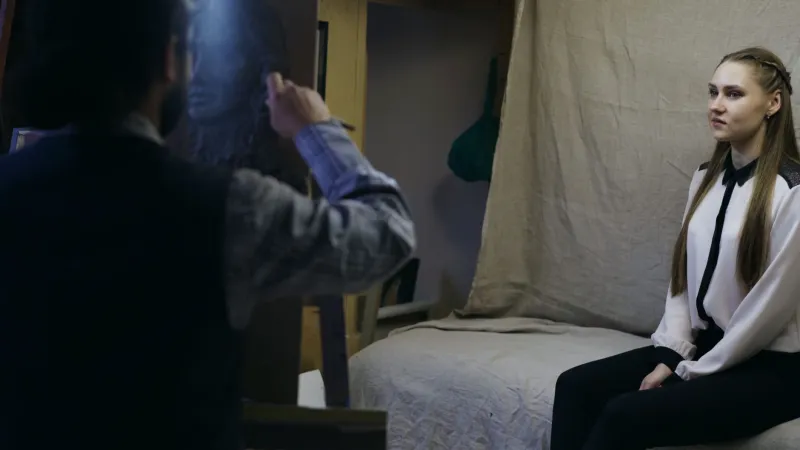
There is a moment, well known to portrait painters, when the subject stops being a collection of features and becomes a face. The eyes acquire a particular weight. The jaw carries a suggestion of character. The light falls across the cheekbones in a way that reveals something the mirror never quite shows. It is in that moment — before a single brushstroke is made — that the composition is truly decided.
The finest cosmetic dentists operate in precisely the same way, even if they rarely describe it in those terms.
In an era when smile design is often reduced to digital overlays, percentage-based golden ratios, and trend-driven aesthetic templates, there is a quiet but significant movement among artisan practitioners who insist that portraiture — its principles, its patience, its profound respect for the individual face — offers a more honest and more lasting foundation for transformative dental work.
The Limits of the Formula
For decades, cosmetic dentistry has leaned heavily on mathematical frameworks. The golden proportion, the recurring ratio of approximately 1.618 to 1, has been applied to tooth width relationships with the confidence of a geometric proof. Smile arc calculations, midline alignment charts, and buccal corridor analyses have given clinicians a reassuring sense of objectivity.
And yet, patients who receive technically flawless smiles sometimes report an unsettling feeling they struggle to articulate: their new teeth look correct, but not quite like them.
This is the limitation that portraiture exposes. A formula can produce symmetry. It cannot produce resonance.
Classical portrait artists — from Sargent to Vermeer — understood that strict symmetry is, paradoxically, one of the least compelling qualities a face can possess. The slight asymmetry of a jaw, the particular way one eye sits fractionally higher than the other, the character written into the corners of a mouth that has laughed and grieved and aged: these are not imperfections to be corrected. They are the very elements that make a face recognizable, and more importantly, beautiful in a way that endures.
A dentist who approaches treatment planning the way a portraitist approaches a sitting — with genuine curiosity about what makes this particular face distinctive — will make fundamentally different decisions than one who is simply optimizing measurements.
Reading the Face Before Addressing the Teeth
Portrait artists speak of negative space: the areas surrounding a subject that shape how the subject itself is perceived. In facial aesthetics, the teeth exist within an elaborate system of negative and positive space — the lips, the gum line, the midface volume, the jawline, the eyes above. Change one element, and the entire composition shifts.
This is why experienced cosmetic dentists who draw on artistic principles often spend a considerable portion of a consultation simply observing. They study the patient at rest and in conversation. They note how the lips move, how much tooth is visible during a natural smile versus a posed one, how the face changes with laughter. They consider the patient's age — not to impose a youthful template, but to understand the narrative the face is already telling and how a restored smile might honor rather than contradict it.
This observational discipline has direct clinical consequences. A patient in their fifties, for instance, may have a slightly longer lower face and a midface that has softened with time. Designing a smile with the same incisal edge position that might suit a thirty-year-old patient could look incongruous — technically correct by the numbers, but visually discordant in the way that an anachronistic detail in a painting disrupts an otherwise coherent composition.
Light, Shadow, and the Illusion of Dimension
One of the most underappreciated intersections between portraiture and dentistry involves the behavior of light. Portrait painters are obsessed with it — the way light defines form, creates depth, and guides the viewer's eye across a composition. Dental ceramists and cosmetic dentists who think like artists are equally attentive to how light interacts with tooth structure.
Natural teeth are not uniformly opaque. They possess translucency at the incisal edges, subtle surface texture that catches and diffuses light, and internal chromatic variation that shifts from the cervical region to the tip. A tooth that is too flat, too white, or too uniform in texture will reflect light in a way that reads as artificial — not because it fails a mathematical test, but because the eye, trained by a lifetime of perceiving natural surfaces, immediately recognizes the absence of depth.
Ceramists working with skilled cosmetic dentists routinely reference portraiture when describing their craft. The layering of porcelain to create internal luminosity mirrors the glazing techniques of Old Masters who built depth through successive transparent layers. The goal in both cases is the same: to create a surface that the eye perceives as alive.
The Consultation as a Sitting
If the artistic analogy holds, then the initial consultation is not merely a clinical intake appointment — it is a sitting. It is the moment when the practitioner begins to understand not just the structural condition of the teeth, but the aesthetic identity of the person who carries them.
This reframing has practical implications. It suggests that a meaningful smile consultation should include open-ended questions about how the patient perceives their own face, what they find beautiful in others, and what aspects of their current smile feel most foreign to their sense of self. It means looking at old photographs — not to chase a younger version of the patient, but to understand the continuity of their facial story.
It also means resisting the temptation to show patients a single digital preview and ask for approval. A portrait artist does not present a finished sketch at the first sitting and ask the subject to sign off. The image evolves through dialogue, through revision, through a growing understanding of what the subject is actually trying to express.
Personalization as the Highest Standard
The word "personalized" is used so freely in modern healthcare marketing that it risks losing meaning. In the context of artisan cosmetic dentistry, however, it carries genuine weight.
A personalized smile is not one that incorporates the patient's stated preferences into an otherwise standardized template. It is one that could not belong to anyone else — because it was designed in response to a face that belongs to no one else. Its proportions emerge from that specific facial architecture. Its color references the natural undertones of that individual's skin and eyes. Its character reflects the age, history, and personality of the person who wears it.
This is what portrait artists have always understood, and what the most thoughtful cosmetic dentists are increasingly embracing: the goal is not the perfect smile in the abstract. The goal is the most truthful, most beautiful version of this particular smile, on this particular face, at this particular moment in a life.
The drill, when it finally comes, should be the last step in a long act of looking.