Clear Aligners, Complex Art: The Hidden Craftsmanship Behind Every Invisalign Smile
There is a certain irony embedded in the phrase "invisible braces." The treatment is designed to disappear — to work its quiet correction without announcing itself to the world. Yet the decisions that determine whether a patient emerges with an ordinary result or a genuinely transformative smile are anything but invisible. They are deliberate, technically demanding, and, at their finest, deeply artistic.
At Artisan Dental Studio, we often describe clear aligner therapy as one of dentistry's most misunderstood procedures — not because it is complicated to explain, but because its complexity is so thoroughly concealed. Patients see the transparency of the trays and assume simplicity. What they rarely see is the sophisticated design process unfolding behind the scenes.
Why Clear Aligners Are Not Simply "Braces Without Wires"
Traditional orthodontics operates through a system of brackets and archwires that apply continuous, directionally controlled force to teeth. The physical hardware itself provides the clinician with constant, tactile feedback and a degree of mechanical predictability.
Clear aligner therapy works differently. Each set of trays is engineered to move specific teeth in precise increments — typically between 0.1 and 0.3 millimeters per tray — relying on the accuracy of the digital treatment plan rather than real-time mechanical adjustment. This means that the artistry must happen upstream, before a single tray is printed. Every rotation, every intrusion, every torque correction must be anticipated and mapped with exacting foresight.
The margin for error is narrow. A miscalculation in the digital plan does not reveal itself immediately; it accumulates across dozens of trays, often surfacing only when the final result diverges from the intended one. This is precisely why experienced clinical judgment — the ability to read a face, a bite, and a smile holistically — matters as much as the technology itself.
The Role of Tooth Positioning in Aesthetic Outcomes
Orthodontic correction is frequently discussed in terms of alignment: are the teeth straight? Are the spaces closed? Is the bite functional? These are necessary questions, but they are not sufficient ones when the goal is a smile that is genuinely beautiful rather than merely corrected.
Consider the concept of smile arc — the gentle curve formed by the edges of the upper front teeth and their relationship to the curvature of the lower lip. A well-designed smile arc creates a sense of harmony and youthfulness. An overlooked one, even in an otherwise well-aligned case, can produce a result that feels flat or aged.
With clear aligners, preserving or improving the smile arc requires careful attention to how teeth are intruded or extruded during treatment. Because aligners exert force differently than traditional brackets, certain movements — particularly extrusion and torque — are inherently more challenging to achieve predictably. A clinician who understands these mechanical limitations will design a treatment plan that works with them, rather than against them, often incorporating auxiliary techniques such as precision attachments to guide the teeth with greater control.
Tooth angulation adds another layer of nuance. The degree to which each tooth tilts within the arch affects not only the bite but the way light reflects off the smile — a consideration that sits squarely at the intersection of science and aesthetics.
Shade Progression and the Cosmetic Timeline
Many patients pursuing Invisalign are simultaneously interested in whitening their teeth, and the sequencing of these treatments carries real aesthetic consequences that are easy to underestimate.
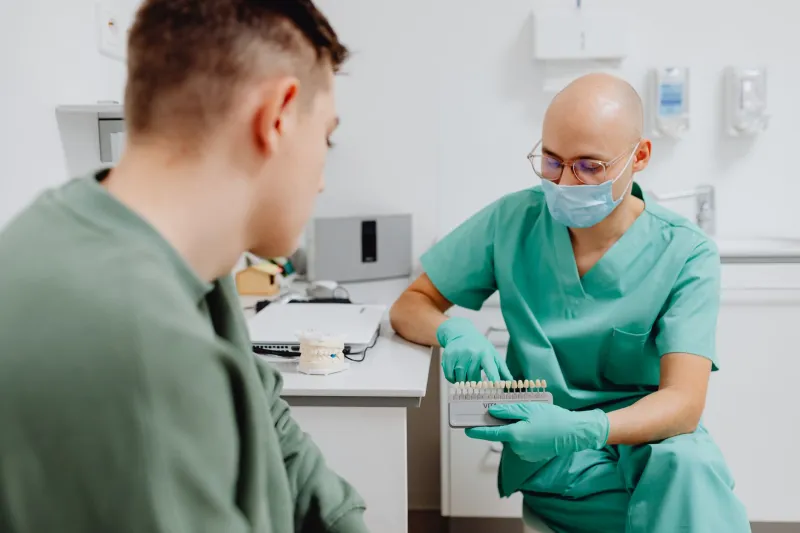
Teeth shift in position throughout aligner therapy. The way a tooth reflects color and light changes as its angle within the arch changes. Beginning a whitening regimen mid-treatment can produce uneven shade distribution that looks perfectly calibrated at one stage and noticeably patchy at another. For patients who plan to follow orthodontic treatment with veneers or bonding, the shade selection process must account for the final tooth positions — not the intermediate ones.
At Artisan Dental Studio, we approach the cosmetic timeline as a single, integrated plan. Shade decisions are made in the context of where the smile is going, not simply where it is. This kind of forward-looking design is what separates a reactive treatment plan from a truly composed one.
Gum Architecture: The Frame Nobody Talks About
Among the most overlooked variables in clear aligner outcomes is the gum line. Because Invisalign moves teeth without the visual reference points that brackets provide, changes in gum position — subtle recession, minor asymmetry, or uneven tissue height — can become more apparent as the teeth shift into their final positions.
In some cases, this is a welcome development: correcting a deep overbite, for instance, can improve the proportional relationship between teeth and gums in ways that patients find genuinely surprising. In others, treatment may reveal tissue irregularities that were previously masked by crowding or overlap.
Gum contouring, whether performed before or after aligner therapy, can serve as a critical finishing element in these cases. The decision of when to involve soft tissue reshaping — and how to plan for it within the broader treatment arc — requires the kind of comprehensive aesthetic awareness that defines truly patient-centered care.
Attachments: The Invisible Infrastructure
Perhaps the clearest evidence that clear aligner therapy is not as passive as it appears is the use of attachments — small, tooth-colored composite shapes bonded to specific teeth to help the aligner grip and move them more effectively.
Attachments are engineered to precise dimensions and placed at calculated angles. Their shape dictates the type of force the tray can apply, and their placement is a clinical decision with significant aesthetic implications. A poorly positioned attachment can interfere with the way the aligner seats, compromise tooth movement efficiency, or even create minor cosmetic concerns during treatment.
Designing an attachment protocol is, in its own way, a form of sculptural planning — a deliberate mapping of small forms to achieve large results.
The Artisan Perspective
Clear aligner therapy represents one of modern dentistry's most elegant paradoxes: a treatment that achieves visible transformation through invisible means, yet demands a level of visible artistry that only becomes apparent in the quality of the final result.
Patients who choose this path deserve a clinician who understands that the transparency of the trays does not simplify the process — it raises the stakes. Every aesthetic decision, every sequencing choice, every millimeter of planned movement contributes to a smile that either feels composed or merely corrected.
At Artisan Dental Studio, we believe that the finest orthodontic outcomes are not produced by software alone. They are produced by clinicians who bring the same deliberate eye to digital treatment planning that a sculptor brings to a block of stone — seeing the final form before the first cut is made.