Why Your Smile Looks Different in Every Reflection: The Optics and Psychology Behind the Contradiction
There is a peculiar moment many patients describe during their first consultation at Artisan Dental Studio. They arrive convinced that something is wrong with their smile—perhaps the teeth appear crowded, discolored, or disproportionately small—only to discover that a calibrated dental photograph tells a meaningfully different story. Conversely, others arrive satisfied with their reflection, yet a clinical image reveals subtle asymmetries they had never noticed. Neither person is wrong. They are simply looking through different lenses—literally and figuratively.
Understanding why your smile appears differently across various viewing contexts is not a trivial exercise. It sits at the very heart of informed cosmetic decision-making.
The Mirror Is Not a Neutral Witness
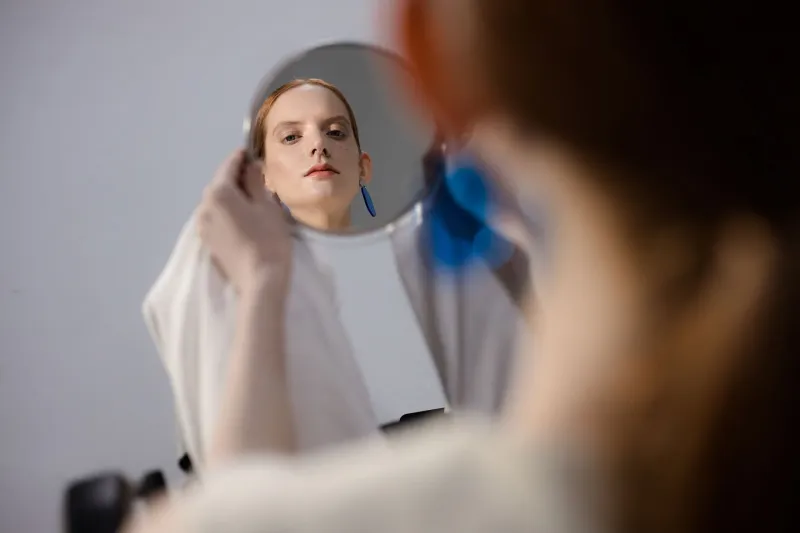
Most of us treat the bathroom mirror as the definitive record of our appearance. In reality, it is one of the least reliable. When you look at your reflection, you are seeing a reversed image of your face—your left and right sides are transposed. Because no face is perfectly symmetrical, this reversal can make familiar features feel subtly wrong even when nothing has changed.
Beyond laterality, there is the matter of distance and habitual expression. People tend to hold a fixed, guarded expression when examining themselves in a mirror. The muscles around the mouth tighten slightly, the lips press together with more tension than they would in a natural social smile, and the jaw often shifts. The smile you are critiquing may not be the smile the world actually sees.
Lighting compounds the problem further. Bathroom fixtures frequently cast overhead or side-angled light that creates harsh shadows in the spaces between teeth, making minor gaps or slight rotations appear far more pronounced than they are in diffuse, natural light.
What Your Phone Camera Is Actually Doing to Your Face
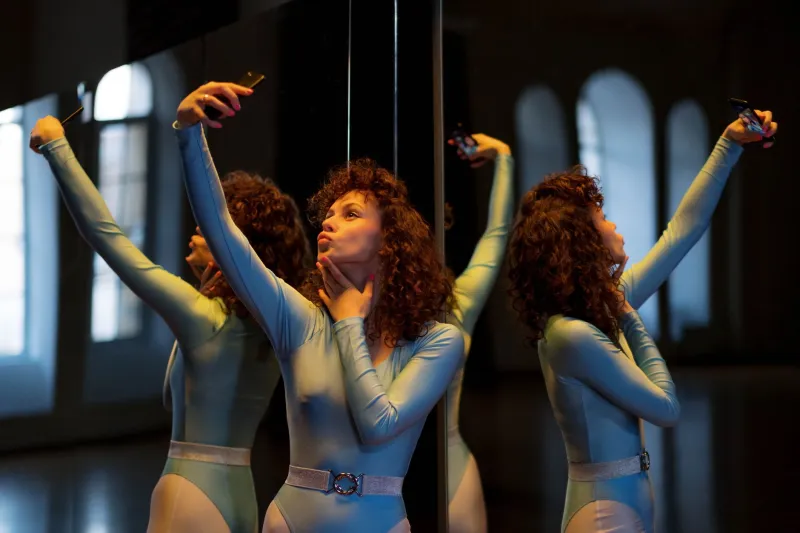
Smartphone selfie cameras are engineered for convenience, not clinical accuracy. Most front-facing cameras have a wide-angle focal length—typically in the range of 23 to 28mm equivalent—which introduces barrel distortion at the edges of the frame. When your face occupies the center of that frame, your nose may appear larger and your ears smaller than they are in reality. Teeth near the corners of your mouth can appear to recede, while central incisors are pushed slightly forward.
The distance at which you hold your phone also matters enormously. Holding a device twelve inches from your face produces a very different geometric relationship between your features than holding it at arm's length. Closer proximity exaggerates the relative size of whatever is nearest to the lens—including your front teeth—while compressing the apparent depth of your smile.
Filter technology adds yet another layer of distortion. Many popular social media platforms apply automatic skin-smoothing, brightness enhancement, and even subtle reshaping algorithms before you ever tap the shutter. The gleaming smile you see in a filtered selfie may be partially a product of software, not enamel.
Why Professional Dental Photography Tells a Different Story
At Artisan Dental Studio, clinical photography is conducted with purpose-built equipment: macro lenses, calibrated ring flash units, and standardized working distances. These tools are chosen specifically to eliminate the distortions that consumer cameras introduce. A macro lens at the correct focal length reproduces the proportions of your teeth with a fidelity that neither a bathroom mirror nor a smartphone can match.
Ring flash lighting eliminates directional shadows, revealing the true contour of each tooth surface, the actual color distribution across the enamel, and the genuine relationship between the gum line and the incisal edges. This is not flattering photography—it is honest photography, and that honesty is what makes it clinically valuable.
When patients see their smiles through this lens for the first time, reactions vary. Some feel relieved: the concerns that loomed large in their mirror are considerably less dramatic in clinical images. Others gain clarity about issues they had dismissed as vanity, recognizing that what felt like an aesthetic preference is actually a functional or structural matter worth addressing.
The Role of Psychological Perception Bias
Optics alone do not explain the full contradiction. Human perception carries its own distortions, shaped by familiarity, emotional state, and social comparison.
Research in perceptual psychology consistently demonstrates that people evaluate their own faces more critically than they evaluate the faces of others. This negativity bias is amplified when we are anxious or self-conscious, and it tends to fixate on specific features—a phenomenon sometimes called the spotlight effect. If you have spent years focused on the appearance of your lateral incisors, your brain has essentially trained itself to detect and amplify any perceived flaw in that region, regardless of whether an outside observer would notice it at all.
Social media further calibrates our internal benchmarks. Repeated exposure to curated, filtered, and professionally lit smiles shifts what feels normal. Patients sometimes arrive with aesthetic concerns that are, in clinical terms, entirely within the range of natural variation—but that feel aberrant against the backdrop of an algorithmically curated feed.
This is not a reason to dismiss aesthetic concerns. It is, however, a reason to examine them carefully before making irreversible decisions.
Translating Perception Into Informed Action
The artistry that defines cosmetic dentistry at its best is not only applied to the teeth themselves—it is applied to the process of understanding what a patient actually sees and what they genuinely need. A skilled cosmetic dentist functions, in part, as a visual interpreter: helping patients distinguish between optical artifacts, psychological amplification, and real clinical findings.
There are several practical steps that support clearer self-assessment. First, look at photographs taken by others in natural daylight, at a conversational distance, without filters applied. These images tend to approximate how your smile reads in social contexts more accurately than either a mirror or a selfie. Second, pay attention to how your smile feels in motion—when you are laughing or speaking—rather than in a static, self-conscious pose. Third, consult a dental professional who uses standardized clinical photography as part of the diagnostic process, so that subjective impressions can be compared against objective documentation.
Understanding the optics of self-perception does not diminish the validity of aesthetic goals. It sharpens them. When a patient arrives with a clear, accurate picture of what they are actually seeing—and what they genuinely hope to change—the conversation about treatment becomes more precise, more productive, and ultimately more satisfying for everyone involved.
At Artisan Dental Studio, every smile transformation begins with that kind of clarity. Before any treatment is proposed, we take the time to see what you see, understand why you see it, and help you determine what is worth pursuing with the full confidence that comes from informed, eyes-wide-open decision-making.