When a Beautiful Smile Doesn't Belong to the Face Wearing It: The Architectural Failures of Cookie-Cutter Cosmetic Dentistry
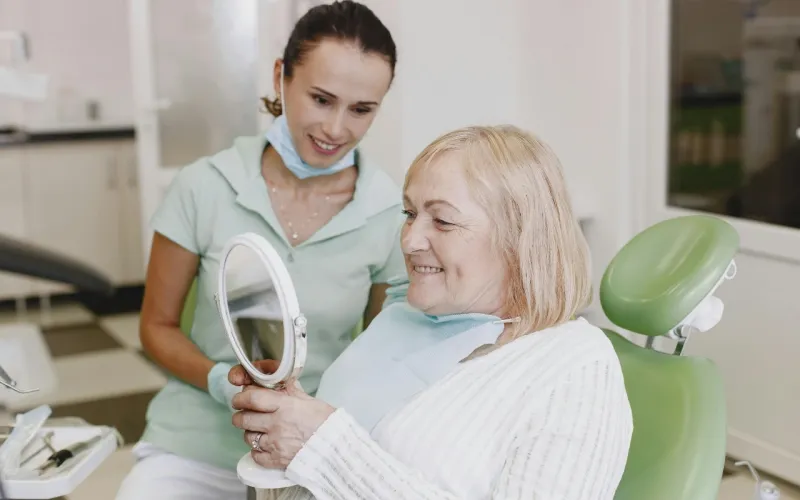
Photo: cosmetic dentist examining patient facial proportions smile consultation, via www.midbaydental.com
There is a particular kind of uncanny that emerges when something beautiful exists in the wrong context. A chandelier suited to a grand ballroom looks absurd suspended in a studio apartment. The same principle applies, with remarkable precision, to cosmetic dentistry. A smile engineered to resemble a catalog ideal — uniformly white, symmetrically aligned, dimensionally proportioned to some average of averages — can appear deeply artificial when placed within a face that was never designed to carry it.
This is not a minor aesthetic inconvenience. For patients who have invested significantly in cosmetic dental work, the realization that their new smile feels foreign, or that others respond to it with subtle unease rather than admiration, can be genuinely distressing. Understanding why this happens demands a conversation about dental architecture — and about the difference between a practitioner who applies a formula and one who reads a face.
The Illusion of the "Perfect" Smile
American popular culture has long promoted a specific dental aesthetic: bright white teeth, even in length, squared at the edges, filling the mouth with confident uniformity. This image has been reinforced by decades of Hollywood productions, television advertising, and more recently, the curated perfection of social media. The result is that many patients arrive at cosmetic consultations with a mental image of what they want — and that image is frequently borrowed from someone else's face.
The challenge for any skilled cosmetic dentist is that this ideal exists in a vacuum. It is unmoored from bone structure, lip architecture, facial width, skin tone, age, and the dozens of other variables that make each human face a singular composition. When a dentist simply delivers what a patient requests without interrogating whether that request is structurally coherent, the outcome can technically satisfy every specification while aesthetically failing the person wearing it.
This is the central tension at the heart of cosmetic dentistry's most visible shortcomings: the gap between what a smile looks like in isolation and what it communicates within the living context of a specific human face.
Structure Before Surface: What Facial Architecture Actually Means
The term "facial architecture" encompasses several interrelated systems that a thoughtful cosmetic dentist must evaluate before touching a single tooth. The underlying bone structure establishes the spatial relationships between the jaw, the cheekbones, and the orbital rims. The soft tissue — lips, gums, the musculature of the lower face — drapes over that framework in ways that shift with expression and age. The dental midline must align not merely with the nose, but with the entire vertical axis of the face as it exists in natural conversation and movement.
Tooth proportions, meanwhile, are not fixed ideals but relational values. The classical width-to-height ratio often cited in cosmetic dentistry textbooks — approximately 0.75 to 0.80 — describes a statistical average, not a universal law. A patient with a narrower, more elongated facial structure may require teeth that are proportionally taller. A broader, rounder face may call for lateral incisors that are fuller and more assertive. The gum line's curvature must mirror the lower lip's arc in a way that reads as natural rather than constructed.
When these relationships are ignored, the teeth become objects rather than features — elements that sit within the face without integrating into it.
The Correction Consultation: When Previous Work Requires Rethinking
Among the most instructive cases in advanced cosmetic practice are those involving patients who arrive not for an initial transformation, but for a correction of work performed elsewhere. These consultations reveal, with uncomfortable clarity, the consequences of aesthetics divorced from architecture.
Consider the pattern that emerges repeatedly in such cases: a patient in their early forties, with a naturally angular jaw and pronounced cheekbones, who underwent a full set of porcelain veneers at a previous practice. The veneers were fabricated to a standard template — uniform length, a bright A1 shade, rounded incisal edges designed to evoke youth and vitality. On a different face, that prescription might have succeeded. On this particular face, the result was a smile that appeared to belong to someone else entirely. The brightness conflicted with the patient's natural complexion. The rounded edges softened a facial structure that derived its character precisely from its angularity. The uniformity erased the subtle asymmetries that had given the original smile its authenticity.
Correcting such work is a delicate undertaking. It requires not merely fabricating new restorations but reconceiving the entire treatment philosophy — asking, from the beginning, what this face actually needs rather than what the prevailing aesthetic trend prescribes. In many cases, that means selecting a shade that harmonizes with the patient's skin undertones rather than achieving maximum brightness. It means restoring slight variations in tooth length that reintroduce the sense of natural development. It means evaluating the gum line and, where necessary, recontouring soft tissue to create a foundation that supports rather than undermines the final result.
The Artisan Approach: Reading the Face Before Designing the Smile
At Artisan Dental Studio, the consultation process begins not with a shade guide but with observation. Before any discussion of materials, timelines, or procedures, the conversation turns to the patient's face as a whole — its proportions, its dominant features, its expressive character. Photographs are taken under consistent lighting conditions. Facial measurements are recorded. The relationship between the dental midline and the facial midline is assessed in repose and in animation, because a smile that aligns correctly when the patient is still may shift perceptibly when they laugh.
This process reflects a foundational belief: that the dentist's role in cosmetic work is closer to that of a portrait artist than a technician. A portrait artist does not impose a preferred aesthetic onto a subject. They study the subject's specific features and make compositional decisions that serve those features — that amplify what is already compelling while addressing what may be less harmonious. The result is a work that feels inevitable, as though it could not have been made any other way.
The same standard applies to smile design. A well-crafted smile makeover should not announce itself. It should simply make the patient look more fully, more confidently like themselves.
Why This Matters More Than It Used to
The democratization of cosmetic dentistry has been, in many respects, a genuine advancement. More Americans have access to aesthetic dental care than at any previous point in history, and the materials available to contemporary dental laboratories are remarkable in their fidelity and durability. But accessibility has also lowered certain barriers that existed for good reason — among them, the requirement for deep clinical judgment about whether a given aesthetic intervention is appropriate for a given patient.
In a market saturated with before-and-after imagery, discount veneer packages, and practices that process high volumes of cosmetic cases with standardized protocols, the pressure to deliver a visually striking result quickly is considerable. The patient who leaves with a dramatically different smile after a single appointment represents a compelling marketing asset. The patient who leaves with a subtler, more precisely calibrated result — one that required three consultations, facial analysis, and a custom laboratory prescription — may not photograph as dramatically. But they are the patient who, years later, still looks entirely like themselves.
That distinction is, ultimately, what separates cosmetic dentistry as a commodity from cosmetic dentistry as a craft. And it is the distinction that defines the philosophy behind every smile designed at Artisan Dental Studio.