Beyond the Inspiration Board: Why Your Most Beautiful Smile Is Uniquely Yours
The inspiration board has become a fixture of the cosmetic dentistry consultation. Patients arrive with curated collections of images—screenshots of celebrities, influencers, before-and-after composites gathered from social media—each selected because something about that particular smile resonated. The aspiration behind these images is completely understandable. What is less understood is why those images, taken at face value, can lead to outcomes that look precisely wrong on the person who requested them.
This is not a failure of ambition. It is a misunderstanding of what smile design actually requires—and what it means to create something genuinely beautiful rather than something that merely resembles something beautiful on someone else.
The Anatomy of a Trend
Cosmetic dentistry trends follow cultural moments with predictable fidelity. The hyper-white, uniformly rectangular veneer smile that dominated red carpets in the early 2000s gave way to a slightly softer aesthetic, which in turn yielded to the current preference for what is often called the "natural" look—though that term means very different things in different contexts.
What these trends share is that they originate on specific faces, in specific lighting, photographed by professionals whose entire craft involves making subjects look extraordinary. The smile that appears luminous on a particular actress is inseparable from her bone structure, her skin tone, the shape of her lips, the architecture of her nose, and the proportions of her face as a whole. Extracted from that context and applied to a different anatomy, the same dental design may appear incongruous, artificial, or simply off in a way that is difficult to articulate but immediately perceptible.
This is the central limitation of the inspiration board as a design tool: it presents outcomes without context, and context is everything in smile design.
What a Skilled Clinician Actually Evaluates
A comprehensive cosmetic consultation at a practice committed to artisan-level care involves a level of facial analysis that most patients do not anticipate. Before a single treatment is proposed, the clinician is studying a constellation of factors that will ultimately determine what is possible, what is appropriate, and what will look genuinely harmonious.
Facial geometry is the foundation. The width of the smile must relate proportionally to the width of the face. The length of the teeth must complement the height of the upper lip at rest and in motion. The midline of the dental arch should align with the facial midline—but in patients for whom this is not achievable, the experienced clinician knows how to use other visual strategies to create the perception of balance without forcing an anatomically incorrect result.
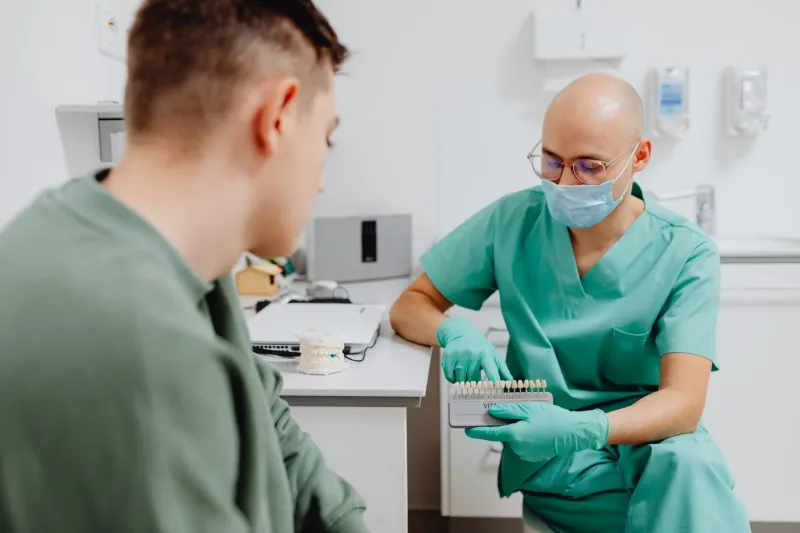
Skin tone and undertone exert a significant influence on how tooth color reads. A shade that appears naturally luminous against a warm, olive complexion may read as stark or gray-toned against a cooler or fairer skin tone. The reverse is equally true. Shade selection in cosmetic dentistry is not a matter of choosing the whitest option available; it is a matter of choosing the shade that interacts most favorably with the patient's specific coloring—including the changing light conditions they will encounter in their daily life.
Age and facial volume inform what is aesthetically appropriate. The longer, slightly more rectangular incisal shape that suits a patient in their twenties may look incongruous on a patient in their fifties, whose facial tissue has undergone the natural volume changes of aging. Conversely, a smile design that respects the patient's age by mimicking the shortened, worn appearance of older teeth does nothing to rejuvenate the overall presentation. The art lies in finding proportions that are youthful without being implausible—that honor where the patient is while presenting the best possible version of that reality.
Personality and lifestyle are less quantifiable but no less important. A patient who is reserved and professional in bearing may feel genuinely uncomfortable with a high-drama smile that draws constant attention. A patient who is expressive and socially prominent may find that a subtle enhancement feels anticlimactic. Understanding what a patient actually wants their smile to communicate—and how that communication will function in the specific context of their life—is as much a part of the design process as any technical measurement.
When Cookie-Cutter Approaches Fail
The consequences of applying a standardized design to an individual face are well-documented in clinical literature and visible in practice waiting rooms across the country. Patients who received veneers sized for a different facial anatomy often describe their smile as looking "fake" or "like I'm wearing a costume." They cannot always explain precisely what is wrong, but they know something is.
In many cases, the problem is proportion. Teeth that are too wide relative to the face create a visual effect sometimes called the "chiclet" appearance—broad, flat, and unmistakably prosthetic. Teeth that are too long relative to the upper lip expose excessive gingival tissue when the patient smiles, drawing attention to the gums rather than the teeth. Shades selected without reference to skin tone can make the face appear sallow or washed out in photographs, even when the teeth themselves are technically well-crafted.
These outcomes are not failures of technical skill alone. They are failures of design philosophy—the result of treating smile transformation as a product to be replicated rather than a composition to be created.
The Artisan Alternative
The practice of personalized smile design begins with a fundamentally different question. Rather than asking "what smile do you want to have?" the conversation shifts toward "what does your best smile look like—and how do we reveal it?"
This distinction is not semantic. It reflects a recognition that the most successful cosmetic outcomes are those that feel inevitable—as though the result was always there, waiting to be uncovered. A smile that is correctly proportioned for a patient's face, appropriately shaded for their coloring, and calibrated to their personality does not draw attention to itself as a dental achievement. It simply makes the person look like the best version of themselves.
Digital smile design technology has made it possible to model proposed outcomes before a single tooth is prepared, allowing patients to evaluate how a design reads on their actual face rather than on a reference image. Diagnostic wax-ups—physical mockups of the proposed restorations—can be placed temporarily in the mouth so the patient can experience the result in three dimensions, in real lighting, in their real life. These tools are not shortcuts; they are instruments of precision that serve the artisan commitment to getting the design right before making it permanent.
Bringing Your Vision Into the Room
None of this means that the inspiration board is without value. Reference images communicate aesthetic preferences, emotional associations, and the general direction a patient hopes to move in—information that is genuinely useful in the early stages of a consultation. The experienced clinician does not dismiss these images; they translate them.
What does the patient love about that particular smile? Is it the brightness, the symmetry, the apparent youthfulness, the sense of vitality? Identifying the underlying quality being sought—rather than the specific form it takes on someone else's face—allows the clinician to pursue that quality in a way that is native to the patient's own anatomy.
The result is not an approximation of someone else's smile. It is an expression of yours—refined, elevated, and unmistakably your own.