When Technically Perfect Feels Emotionally Wrong: The Hidden Disconnect Between Dental Restorations and the Face Behind Them

Photo: woman candid genuine laugh smile natural expression close up portrait, via static.vecteezy.com
There is a particular kind of disappointment that patients rarely know how to articulate. They have invested substantially in cosmetic dentistry. The shade is objectively bright. The symmetry is measurable. Every technical specification has been met. And yet, when they glance at a candid photograph—the kind taken at a family dinner or a work celebration, when no one is posing—something feels off. The smile in the image does not appear to belong to them.
This experience is more common than most dental practices acknowledge, and it points to a gap that no shade guide or digital smile simulation can fully close on its own: the gap between a restoration that is clinically correct and one that is emotionally coherent.
The Uncanny Valley Has a Dental Address
Most people are familiar with the uncanny valley as a concept from animation and robotics—that unsettling zone where a human likeness becomes close enough to the real thing to register as almost right, but not quite right. The near-accuracy is precisely what makes it disturbing. The same phenomenon occurs in cosmetic dentistry, though far fewer practitioners discuss it openly.
When a set of veneers or crowns is designed purely around geometric ideals—standardized proportions, average width-to-height ratios, catalog-selected shades—the result can trigger a similar response in observers, and more importantly, in the patient themselves. The teeth look like teeth. They may even look like very good teeth. But they do not look like those teeth, belonging to that face, animated by that person's particular way of moving through the world.
The problem is not craftsmanship in the conventional sense. The problem is that the design process began with a template rather than a person.
Micro-Expressions Do Not Lie
The human face communicates through an extraordinarily complex vocabulary of micro-expressions—fleeting muscular movements that last fractions of a second and convey emotional states before conscious thought has time to intervene. These expressions are deeply tied to the specific geometry of a person's face: the depth of their laugh lines, the particular arc of their upper lip at rest, the degree to which their lower eyelids rise when a smile is genuine rather than performed.
Dental restorations interact with all of these dynamics, whether the clinician intends them to or not. A tooth length that reads as elegant in a still photograph may appear stiff or theatrical when the patient laughs spontaneously. A central incisor positioned for ideal symmetry on a model may visually compete with the natural asymmetry that gives a particular face its character and warmth.
Artisan dental practice requires observing how a patient's face moves—not merely how it appears in a single static frame. Consultations that include conversation, that invite genuine laughter, that study the relationship between the eyes and the mouth in motion, yield information that no scan or impression can capture alone.
Eye-Tooth Harmony: The Metric Nobody Talks About
Among the most overlooked principles in cosmetic smile design is what might be called eye-tooth harmony: the visual and emotional relationship between a patient's eyes and their teeth when they smile.
A genuine smile—what researchers have long described as a Duchenne smile—involves the orbicularis oculi muscle, which creates the characteristic crinkling at the outer corners of the eyes. When this upper facial movement is present but the lower dental display does not correspond to it in tone, scale, or warmth, observers unconsciously register the mismatch. The eyes say one thing; the teeth say another. The result is a smile that feels performed even when it is entirely spontaneous.
This is not a problem that can be solved by making teeth brighter or more symmetrical. In fact, those interventions can deepen the disconnect. What it requires is a careful study of the patient's natural smile dynamics and a willingness to let those dynamics guide the design, rather than subordinating them to a universal ideal of dental beauty.
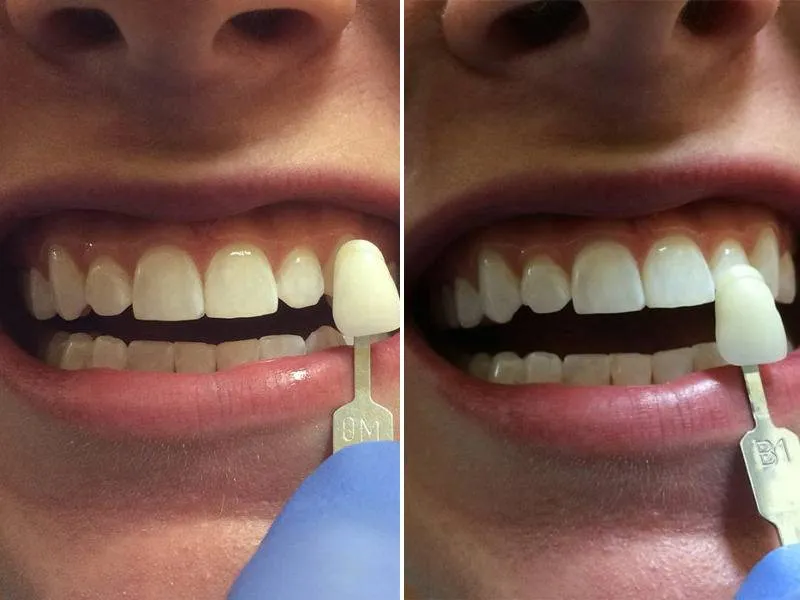
The shade of a restoration, for instance, should not simply be selected against a white background in clinical lighting. It should be evaluated against the patient's skin tone, eye color, and the particular warmth or coolness that characterizes their natural coloring. A shade that photographs beautifully in isolation may read as cold or artificial against a warmer complexion—or conversely, as muddy against a cooler one.
Individual Quirks Are Not Flaws to Be Erased
One of the more consequential assumptions in standardized cosmetic dentistry is that natural dental variation constitutes a problem to be corrected. A slightly rotated lateral incisor. A central incisor that is fractionally longer than convention suggests. A gap that has been present since adolescence and has become, over decades, part of how a person is recognized and remembered.
For many patients, these features carry genuine personal history. Removing them without careful discussion—or designing restorations that systematically smooth away every irregularity in pursuit of a catalog ideal—can produce a result that the patient finds visually alienating in ways they struggle to explain. They may describe the feeling as looking like someone else, or as appearing too perfect, or simply as not quite right. What they are often describing is the absence of themselves.
Artisan-level cosmetic dentistry treats these individual characteristics as information rather than noise. The decision to preserve, modify, or replace any given feature should emerge from a genuine conversation about identity, expression, and what the patient actually wants their smile to communicate—not from a default assumption that uniformity equals improvement.
Why Patients Hide Smiles They Paid For
The behavioral consequence of this disconnect is telling. Patients whose restorations feel inauthentic often develop subtle avoidance behaviors that they may not consciously recognize: turning slightly away from cameras, keeping their lips more closed than before, covering their mouth when laughing. They continue to perform the smile in controlled, deliberate contexts—professional headshots, formal occasions—but withdraw it from the unguarded moments where it would once have appeared naturally.
This is the opposite of what cosmetic dentistry is intended to achieve. The goal is not a smile that a patient can produce on command. The goal is a smile that arises freely, that they do not think about, that feels continuous with who they are rather than added on top of it.
Achieving that outcome requires a different kind of clinical attention. It requires treating the patient's face as the primary reference document, studying their expressions across multiple contexts, understanding their personal aesthetic sensibility, and building a restoration design that honors the specific human being rather than approximating a demographic average.
The Artisan Standard
At Artisan Dental Studio, the belief that where art meets the science of your smile is not a marketing phrase—it is a clinical methodology. Every smile design process begins with observation rather than prescription. It proceeds through genuine dialogue about what patients value in their own appearance and what they hope their smile will express to the world around them.
Technical excellence is the foundation, never the ceiling. The ceiling is a restoration so well integrated with its patient's face, personality, and natural movement that it becomes simply, unmistakably theirs—present in every photograph, spontaneous in every laugh, and entirely invisible as dentistry.
That is the standard a truly artisan approach demands. And it is the standard every patient deserves.